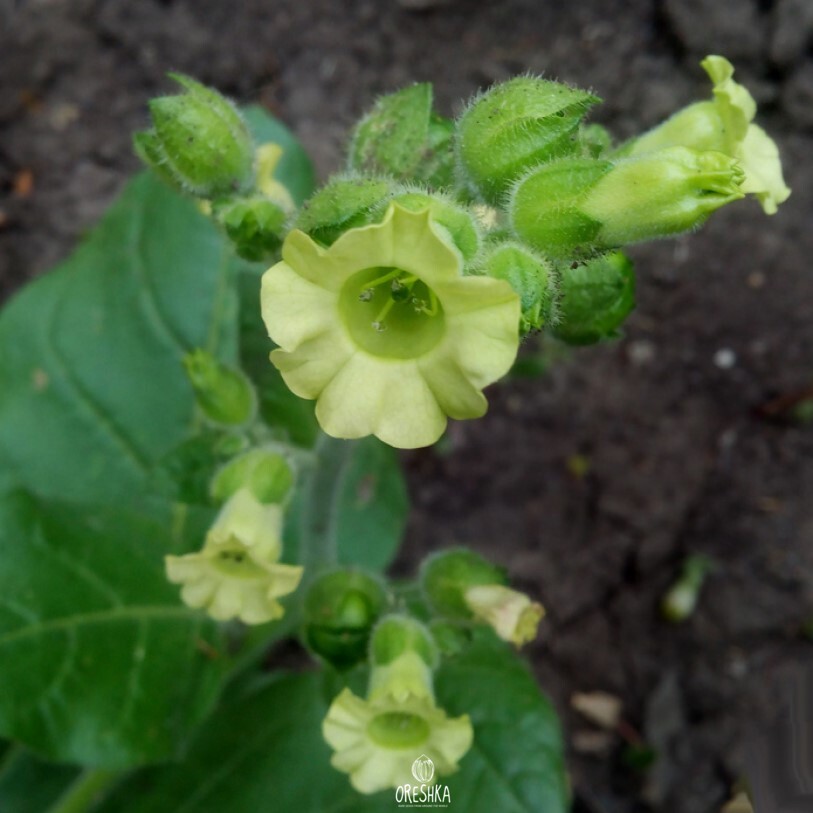
Tobacco Agrotechnics — Germination, Curing & Seasonal Calendar
Step-by-step protocols from germination to cured leaf for all tobacco types.


Two species, six curing methods, 250 cultivars. Everything a home grower needs to pick the right tobacco seed and bring it from tray to cured leaf.
The word “tobacco” covers two distinct species and dozens of curing traditions. A flue-cured Virginia leaf and a Nicotiana rustica Mapacho are both “tobacco” — but they differ in nicotine content by a factor of three to five, require different curing infrastructure, and produce entirely different end products. Choosing the wrong type is the single most common mistake new growers make.
Nicotiana rustica contains 5–9% nicotine versus 1–3% in Nicotiana tabacum. They are separate species that diverged roughly 750,000 years ago — as genetically distant as wheat and barley. Treating them as interchangeable leads to failed crops and unusable leaf.
This guide breaks down every major tobacco type by leaf chemistry, curing method, end use, and growing requirements. It covers 250 varieties currently in stock at Oreshka Seeds — sourced from Russian breeding institutes, heritage Crimean lines, and Central Asian landrace collections. The goal is simple: match the right seed to your climate, your equipment, and your intended use before you sow a single tray.
Our tobacco collection includes cultivars from the VNIITTI (All-Russian Tobacco Research Institute), heritage lines from Krasnodar and Crimea, and landrace makhorka strains from the Urals. Seeds are harvested fresh each season from documented parent plants. About our collection →
Commercial tobacco is divided into five major types by curing method and leaf chemistry. A sixth category — specialty and heritage varieties — captures everything that does not fit neatly into the commercial framework: ornamental Nicotiana, Soviet-era experimental lines, and rare regional landraces.
Each type has distinct leaf chemistry, a specific curing process, and a different end use. Picking the right type is the first and most consequential decision.
The world’s most widely grown tobacco type, accounting for roughly 40% of global production. Leaves are cured by indirect heat from flues (metal pipes) over 4–7 days at 60–75°C. The rapid heat fixes sugars in the leaf — Virginia has the highest sugar content of any cured tobacco at 15–25%. Flavour is mild, bright, and slightly sweet. The classic base for cigarettes, roll-your-own blends, and many pipe tobaccos.
Air-cured in ventilated barns for 4–8 weeks. The slow process strips chlorophyll and sugars, leaving a brown leaf with less than 1% residual sugar. This dry, porous structure absorbs casing flavours (chocolate, vanilla, liquorice) better than any other type — which is why Burley is the backbone of most American-blend cigarettes and flavoured pipe tobaccos. Stronger body than Virginia, with a nutty, slightly cocoa-like base taste.
Small-leafed aromatic tobaccos grown historically in the Mediterranean basin, Balkans, and Middle East. Sun-cured on open frames for 2–4 weeks. Leaves are only 5–15 cm long — one-tenth the surface area of a full Virginia leaf. What they lack in size they compensate in flavour: complex, spicy, slightly sweet aromatics that form the “condiment” layer in English and Balkan pipe blends. Includes Basma, Dubek, Izmir, Latakia, and Perique sub-types.
A completely separate species from commercial tobacco. Nicotiana rustica contains 5–9% nicotine — three to five times the concentration of N. tabacum. Leaves are thick, dark, and coarse-textured. In Russia and Eastern Europe, rustica was the dominant tobacco crop for centuries under the name makhorka, smoked in pipes or hand-rolled. In South America, it is known as Mapacho and used in Amazonian ceremonial practice. Air-cured or sun-cured. Short growing season — matures 10–15 days earlier than most tabacum cultivars.
Cigar tobacco encompasses three functional roles: wrapper (the outer visible leaf, thin and elastic), binder (structural middle layer), and filler (the core that provides body and flavour). Each role requires different curing conditions. Wrapper leaves are the most valuable agricultural product per hectare in commercial tobacco farming. Air-cured for 3–6 weeks, then fermented in bulk (“sweating”) for several months to develop flavour and reduce harshness.
Everything that does not fit the five commercial categories: ornamental Nicotiana grown for flowers rather than leaf (N. sylvestris, N. suaveolens), Soviet-era experimental crosses bred for disease resistance or alkaloid research, regional landraces preserved by village growers across Eastern Europe and Central Asia, and dual-purpose cultivars selected for both smokable leaf and decorative garden use. This is the largest category in the Oreshka collection and the one most likely to contain varieties unavailable anywhere else.
Tobacco is an annual crop. The full cycle from sowing to finished cured leaf takes 5–7 months depending on type and climate.
Tobacco seeds are among the smallest of any cultivated crop — roughly 12,000 seeds per gram. Surface-sow on moist seed-starting mix under fluorescent or LED light (16 hours/day). Do not cover with substrate. Maintain 24–28°C. First sprouts appear in 7–14 days.
Seedlings are extremely small at this stage — 2–4 mm. Keep humidity at 70–80% using a dome or cling film. Begin light air circulation after week 3 to prevent damping off. Do not fertilise yet.
At the 4-true-leaf stage (roughly 3–5 cm tall), transplant seedlings into individual cells or 7 cm pots. Begin feeding with half-strength liquid fertiliser every 10 days. Plants should reach 12–15 cm by the end of week 8.
Harden seedlings over 7–10 days by gradually increasing outdoor exposure. Transplant into the field or final containers at a spacing of 45–60 cm between plants. Tobacco is killed by even a light frost — do not rush this step.
Tobacco grows rapidly once established — Virginia and Burley reach 1.5–2 m tall. When the flower bud appears, remove it (“topping”) to redirect energy into leaf size and weight. Expect 18–22 harvestable leaves per plant in open ground.
Harvest begins when bottom leaves turn yellow-green and feel slightly sticky. Pick from the bottom up over 3–4 weeks. Curing time varies by type: flue-cured Virginia takes 4–7 days of active heat, air-cured Burley needs 4–8 weeks in a ventilated barn, and sun-cured Oriental requires 2–4 weeks on outdoor frames.
Fine-grade peat or coco coir mixed 1:1 with perlite. pH 5.8–6.5. Must hold moisture evenly across the surface — tobacco seeds are too small to push through clumps.
Tobacco seeds require light to germinate — this is non-negotiable. A grow light or sunny south-facing windowsill producing 2,000–5,000 lux at tray level. LED panels at 15–20 cm distance work well.
Clear plastic dome or cling film to maintain 70–80% humidity during the first 3 weeks. Remove gradually once seedlings are 1 cm tall to prevent damping off.
Depends on type. Air-cured (Burley, Rustica): a ventilated shed or covered porch for 4–8 weeks. Flue-cured (Virginia): a heat source maintaining 60–75°C for 4–7 days. Sun-cured (Oriental): open-air racks in direct sun.
Fill a shallow tray with pre-moistened seed-starting mix. Scatter tobacco seeds thinly across the surface — do not press them in and do not cover with substrate. Tobacco seeds are photoblastic: they require light to trigger germination. Mist the surface lightly to settle seeds into contact with the medium.
Place the tray under a grow light or on a bright windowsill providing 16 hours of light per day. Cover with a clear dome to hold humidity at 70–80%. Keep temperature at 24–28°C. Bottom heat from a propagation mat speeds germination. Do not let the surface dry out — mist daily if needed.
First sprouts appear as tiny green dots barely 1 mm across. Virginia and Burley types typically germinate in 7–10 days; Rustica can take 10–14 days. Once seedlings are visible, begin opening the dome for 30 minutes per day to reduce humidity gradually and prevent damping off.
When seedlings have 4 true leaves and stand roughly 3–5 cm tall, transplant them into individual 7 cm pots or cell trays. Handle by the leaves, never the stem. Use the same seed-starting mix. Begin feeding with half-strength liquid fertiliser (NPK 10-10-10 or similar) every 10 days.
Once all frost risk has passed, harden seedlings over 7–10 days by increasing outdoor exposure. Transplant into the field or large containers at 45–60 cm spacing. Tobacco demands full sun — minimum 6 hours direct light per day. Water deeply at transplant and mulch to retain moisture.
When the flower bud appears (typically 60–75 days after transplant), snap it off to redirect growth energy into the leaves. This increases leaf size and nicotine concentration. Begin harvesting when the lowest leaves turn yellow-green and feel slightly tacky — pick 2–3 leaves per week, working upward over 3–4 weeks. Cure according to the method appropriate for your tobacco type.
The VNIITTI (Russian Tobacco Research Institute) bred cultivars specifically for short-season northern growing. Lines like Sobolchesky 193, Talgar, and Eletskaya produce usable leaf in Zone 5 climates with as few as 90 frost-free days — compared to 120+ days required by most American Virginia lines.
Nicotiana rustica cultivars (Makhorka, Mapacho) reach harvestable maturity 10–15 days earlier than N. tabacum types. In climates where the growing window is tight — Scandinavia, Scotland, northern Russia — rustica is often the only reliable option for outdoor leaf production.
Crimean tobacco-growing tradition dates to the 18th century. Several Oreshka cultivars descend from Crimean aromatic lines originally bred for Turkish-style pipe blends. These are adapted to alkaline soils (pH 7.0–7.8) and hot, dry summers — conditions that would stress most Burley cultivars.
Tobacco seed stored cool and dry (15°C, 30–40% RH) retains 80%+ germination for 3–5 years. A single pack of 300 seeds from Oreshka is enough for multiple seasons of small-scale production. No rush to sow everything in year one.
Side-by-side data to help you choose the right type for your growing conditions and intended use.
| Feature | VirginiaN. tabacum · Flue-cured | BurleyN. tabacum · Air-cured | OrientalN. tabacum · Sun-cured | RusticaN. rustica · Air/Sun |
|---|---|---|---|---|
| Nicotine % | 1–3% | 2–4% | 0.5–2% | 5–9% |
| Sugar % | 15–25% | <1% | 5–12% | <3% |
| Curing method | Flue heat, 4–7 days | Barn air, 4–8 weeks | Sun frames, 2–4 weeks | Air or sun, 3–6 weeks |
| Leaf size | 40–70 cm | 50–75 cm | 5–15 cm | 15–30 cm |
| Days to harvest | 80–100 | 70–90 | 75–95 | 60–80 |
| Plant height | 1.5–2 m | 1.5–2 m | 0.8–1.2 m | 0.6–1.2 m |
| End use | Cigarettes, RYO, Pipe | American blends, Pipe, Chew | Pipe blends, Turkish cigs | Pipe, ceremonial |
| Beginner friendly? | Yes | Yes | Intermediate | Yes (but strong) |
Tobacco seeds are photoblastic — they require light on the seed coat to trigger germination. Covering them with even 1–2 mm of soil will reduce germination rate by 80–90%. Always surface-sow and press gently to make contact with the moist medium.
Tobacco has zero frost tolerance. Even a brief exposure to –1°C kills seedlings outright. In Zone 5–6 climates, the safe window often does not open until late May or early June. Always wait 1–2 weeks past the average last frost date before transplanting.
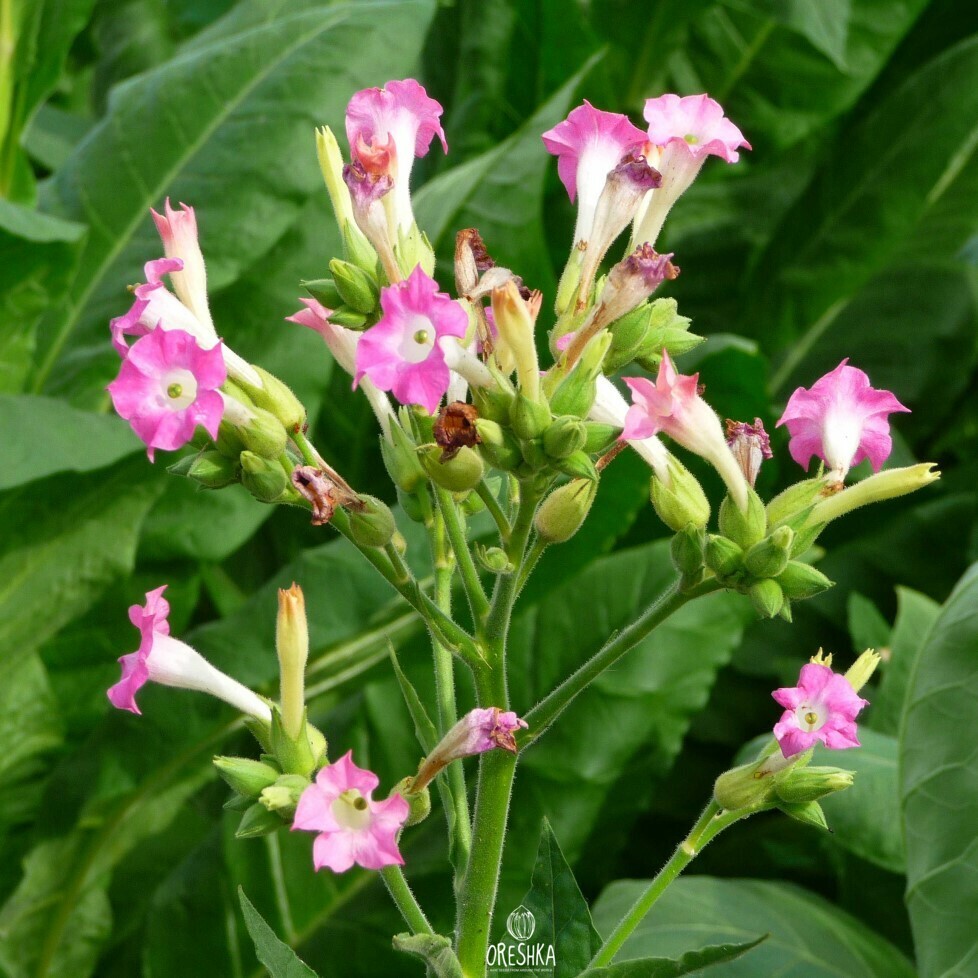
Leaving the flower head intact diverts energy from leaf growth to seed production. Topped plants produce 20–30% larger leaves with measurably higher nicotine and sugar concentrations. Remove the flower bud as soon as it appears — unless you are saving seed.
Each tobacco type requires a specific curing process to develop its intended flavour profile. Air-curing a Virginia leaf produces a dull, flat-tasting result — Virginia needs flue heat to fix its sugars. Flue-curing a Burley leaf destroys its ability to absorb casings. Always match the curing method to the type.
These are different species with different growing habits, nicotine levels, and end uses. N. rustica (Makhorka, Mapacho) is 3–5 times stronger than N. tabacum (Virginia, Burley). Mixing them in a blend without knowing the nicotine difference can produce an unusable or unpleasant result.
Cause: Most likely insufficient light or seeds buried too deep. Tobacco seeds are photoblastic and will not germinate in darkness.
Fix: Re-sow on a fresh surface. Ensure 16 hours of light at 2,000+ lux reaching the seed tray. Confirm temperature is 24–28°C using a thermometer at tray level, not room level.
Cause: Damping off — a fungal infection caused by excess humidity and still air, most common in weeks 2–4.
Fix: Improve air circulation immediately. Remove the humidity dome for progressively longer periods. Water only from below. If the problem persists, drench with a fungicide containing copper hydroxide at 2 g/L.
Cause: Either nitrogen deficiency (premature yellowing from the bottom up) or natural senescence signalling harvestable maturity.
Fix: If yellowing occurs before 60 days from transplant, apply nitrogen-rich fertiliser (30–50 g ammonium nitrate per m²). If it occurs after 70+ days, the plant is simply telling you it is ready to harvest — begin picking those leaves.
Cause: Under-cured leaf that has not completed chlorophyll breakdown, or wrong curing temperature for the type.
Fix: For air-cured types, extend hanging time by 1–2 weeks and ensure barn temperature stays between 18–30°C. For flue-cured Virginia, verify temperature reached 60–75°C during the “killing out” phase. After curing, age leaf in sealed containers for 6–12 months — harsh flavours mellow significantly with time.
One variety per type — available from Oreshka Seeds. Sealed packets, worldwide shipping, 300+ seeds per pack.
Oreshka Seeds stocks 250 tobacco varieties across 6 types: Virginia/Bright Leaf (22 cultivars), Burley (21), Oriental/Turkish (6), Rustica/Shag/Makhorka (36), Cigar/Havana (7), and Specialty & Heritage (158). All packs contain 300+ seeds at €4.25–€5.00.
Virginia and Burley are the most forgiving types for first-time growers. Both germinate reliably at 24–28°C in 7–14 days, tolerate a range of soils, and air-cure or flue-cure without specialist equipment. Virginia Gold (Tob1) is the single most recommended starter cultivar.
They are separate species that diverged roughly 750,000 years ago. N. tabacum (Virginia, Burley, Oriental, Cigar) contains 1–3% nicotine and produces large, thin leaves cured for smoking blends. N. rustica (Makhorka, Mapacho, Shag) contains 5–9% nicotine in smaller, thicker leaves — traditionally used in Russia and South America for pipe tobacco and ceremonial purposes.
Yes. Tobacco is an annual — it does not need to overwinter. Start seeds indoors 6–8 weeks before last frost and transplant after all frost risk has passed. Many Russian-bred cultivars in the Oreshka collection (Sobolchesky 193, Talgar, Eletskaya) were specifically selected for short growing seasons of 90–100 frost-free days.
Expect 5–7 months total: 7–14 days germination, 6–8 weeks of seedling growth indoors, 60–90 days of field growth after transplant, then 3–8 weeks of curing depending on type. Flue-cured Virginia is fastest at 4–7 days of active curing; air-cured Burley takes 4–8 weeks.
Yes, but yields are lower. Use at least a 20-litre container per plant. Dwarf or ornamental Nicotiana varieties perform best in pots. Full-size Virginia or Burley plants reach 1.5–2 m tall and need staking in containers. Expect 8–12 harvestable leaves per potted plant versus 18–22 in open ground.
Browse all 250 varieties at oreshka-seeds.com/tobacco-seeds. Each pack contains 300+ seeds at €4.25–€5.00 with worldwide shipping. Seeds are sourced from Russian breeding collections including VNIITTI institute cultivars, heritage Crimean and Krasnodar lines.
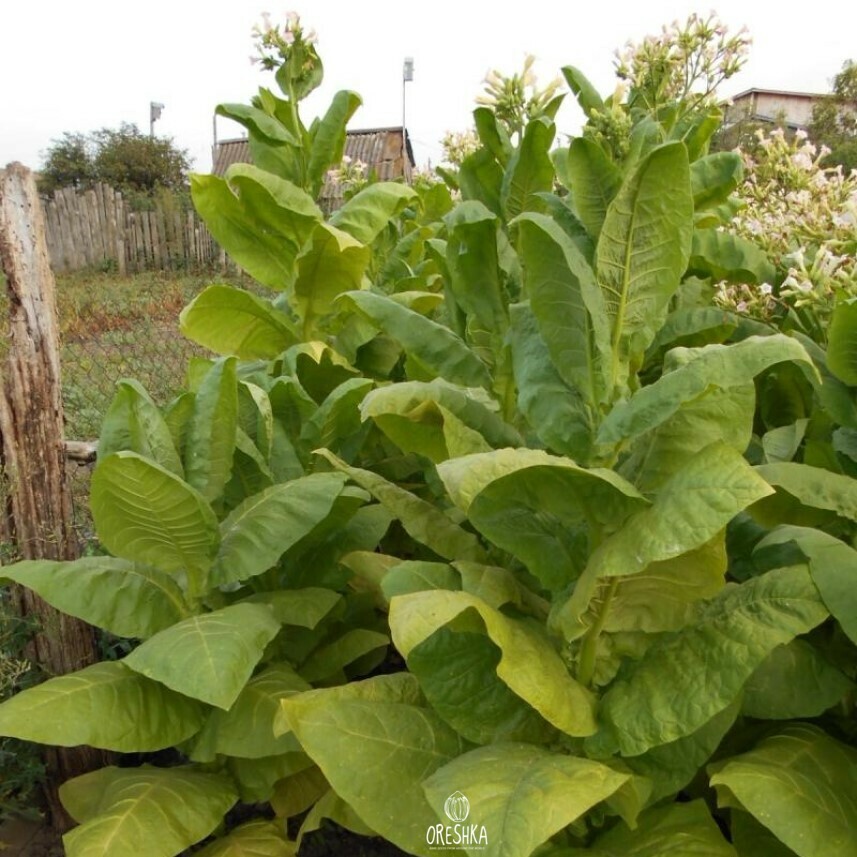 AGROTECHNICS
 Step-by-step protocols from germination to cured leaf for all tobacco types.
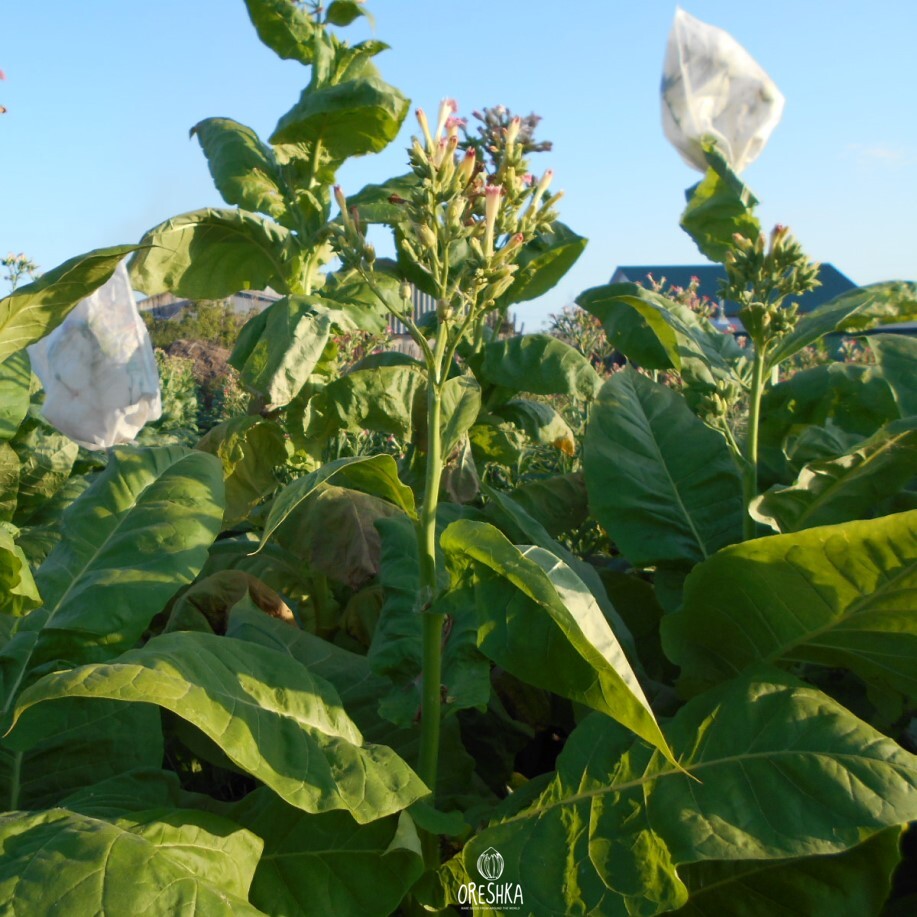 SEED GUIDE
 Expert tips on climate, germination, seed quality, and long-term plant success.
 SEED STARTING
 Step-by-step guide with germination tips, soil, light, watering, and common mistakes.
250 varieties · Worldwide shipping · 300+ seeds per pack · Open-pollinated
Shop Tobacco Seeds →oreshka-seeds.com · Sealed packets · 2–3 day dispatch