

How to Grow African Tulip Tree from Seed
Spathodea campanulata — Flame of the Forest · Nandi Flame · Fountain Tree
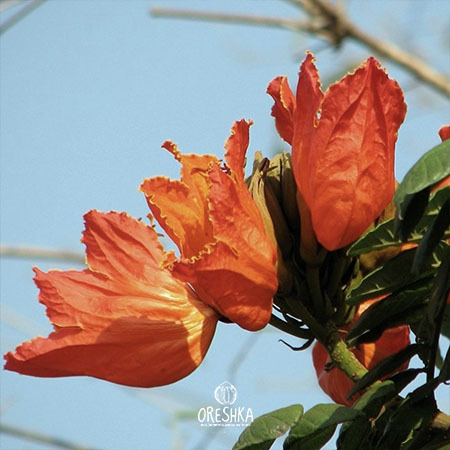
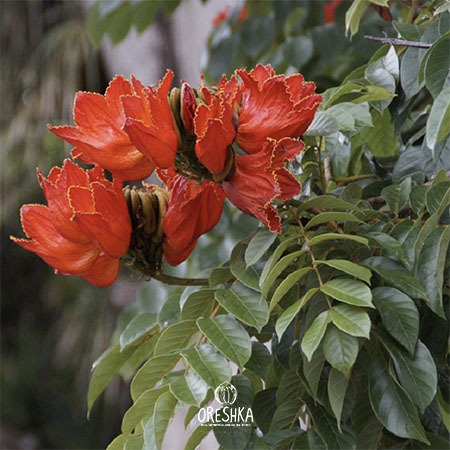
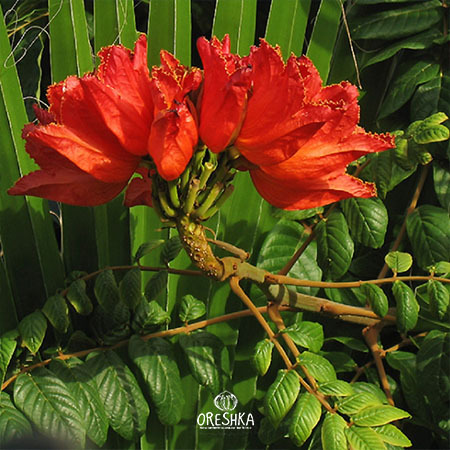
One of the most spectacular flowering trees of the tropics — clusters of 12 cm scarlet-orange tulip-shaped blooms at branch tips, almost year-round. The flower buds hold water inside and squirt when pressed — earned it the name 'Fountain Tree'. Grows in any soil, including the poorest. National tree of Ghana.
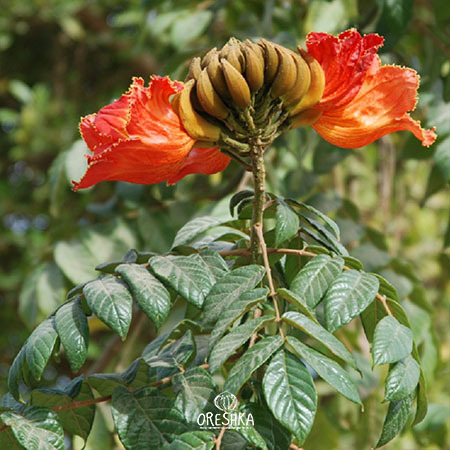
The tree
What is the African Tulip Tree — and Why Do its Buds Hold Water?
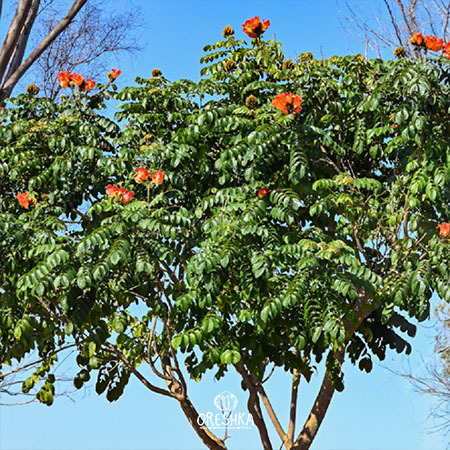
Spathodea campanulata is an evergreen tree native to tropical Africa, reaching 20 m with grey-brown bark marked by light grey spots. The leaves are shiny, dark green, pinnate (compound), up to 50 cm long. The flowers are the defining feature: large (12 cm), bright scarlet to red-orange, tulip-shaped, gathered in dense terminal brushes at the branch tips. In tropical conditions the tree flowers almost continuously — a tree in full bloom is visible from hundreds of metres away, which explains 'Flame of the Forest' as a common name. The fruit is a dry oblong capsule up to 20 cm long containing numerous thin-winged seeds that are released and carried by the wind.
Spathodea campanulata is the national tree of Ghana and is widely planted as a street, park, and garden tree throughout tropical Africa, Asia, the Caribbean, and Central America. It tolerates remarkably poor soils — a significant advantage in degraded tropical landscapes where few trees establish well. In temperate climates it is grown as a container specimen, moved outdoors in summer and overwintered frost-free indoors.
Do NOT soak seeds — winged samaras must be sown dry on the surface. 20 seeds per pack. Sow fresh at 24–28°C on the surface — light required for germination. About our collection →
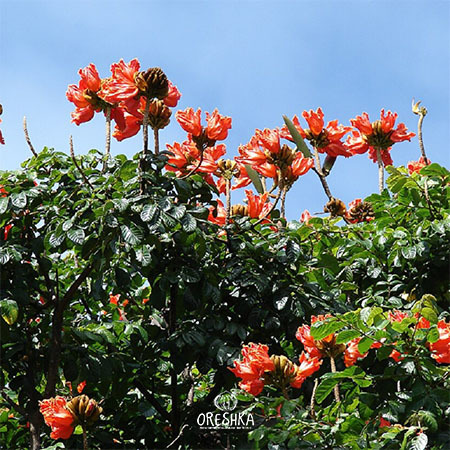
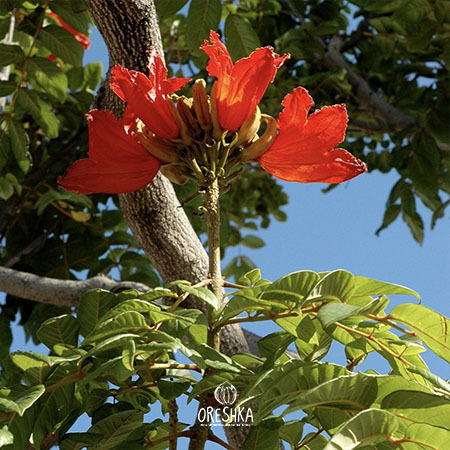
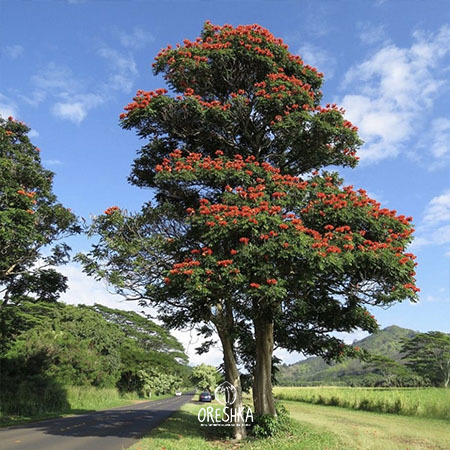
Quick facts
Spathodea campanulata at a Glance
Growing guide
How to Grow African Tulip Tree from Seed — Step by Step
- 01Do NOT Soak — Sow Dry on the SurfaceSpathodea seeds are thin-winged samaras — never soak in water before sowing, as soaking damages the delicate seed membrane and reduces germination. Press seeds lightly onto the surface of warm, moist, well-draining compost. Do not bury. A 1–2 mm layer of fine vermiculite prevents surface drying while allowing light through. Sow all 20 seeds — germination rate varies and sowing the full packet maximises the number of viable seedlings.
- 02Light + Humidity — Propagator at 24–28°CSpathodea requires light for germination — sowing on the surface satisfies this. Cover pot with a clear plastic bag or propagator lid to maintain humidity. Keep at 24–28°C — a propagator mat is strongly recommended. Mist the surface gently if it shows signs of drying — never pour water directly onto seeds. Germination occurs in 14–30 days in optimal conditions; temperatures below 22°C slow the process significantly.
- 03Seedlings — Tropical Warmth and Full LightSeedlings emerge with broad seed leaves followed rapidly by the characteristic dark green pinnate compound leaves. Maintain warmth (minimum 18°C) and maximum light. Move to a sunny windowsill or under grow lights once established. Pot on individually into 9 cm pots of well-draining compost when seedlings reach 5–7 cm. Spathodea seedlings grow fast in warm conditions — 30–60 cm possible in the first year under ideal conditions.
- 04Outdoors in Summer — Sheltered, Full SunMove containers outdoors when night temperatures consistently exceed 15°C (typically late May–early June in northern Europe). Full sun, sheltered from strong winds. Water freely during the growing season; feed monthly with balanced fertiliser. Pot on into progressively larger containers as roots fill the current pot — root restriction is the primary limiting factor on growth rate in container culture.
- 05Overwinter Frost-Free — Min 10–12°CBring indoors before the first autumn frost (late September in temperate climates). Overwinter in a heated conservatory, winter garden, bright living room, or heated greenhouse — minimum 10–12°C. Reduce watering significantly in winter; the plant is not actively growing. Resume regular watering and feeding in March–April as light levels and temperatures increase. Spathodea is semi-dormant at low temperatures but should retain its leaves in a frost-free environment.
- 06Flowering — Patience Rewarded with Spectacular BloomsIn tropical conditions, first flowering begins at 3–5 years. In container cultivation in temperate climates, flowering requires sufficient root and stem development plus a warm, bright growing season — expect 5–8+ years. The wait is worthwhile: when Spathodea flowers, the dense terminal clusters of 12 cm scarlet-orange tulip blooms are among the most spectacular of any container tree. The flower buds also hold water — press a ripe bud gently and it will eject a jet of water.
The single most common failure with Spathodea seeds is soaking them before sowing. Unlike most tree seeds where pre-soaking accelerates germination, Spathodea's thin papery wing membrane is damaged by extended water contact. The correct method — pressing dry seeds onto moist compost surface in a warm propagator — achieves reliable germination in 14–21 days. If germination is slow after 3 weeks, check that the temperature is genuinely reaching 24°C at pot level (not just ambient air temperature) and that the surface compost is staying moist but not wet. Most failures trace back to temperature being insufficient rather than any issue with the seeds themselves.
Compare
Spathodea vs. Delonix regia vs. Jacaranda mimosifolia
| Feature | Spathodea campanulata African Tulip Tree · L128 | Delonix regia Flamboyant / Royal Poinciana | Jacaranda mimosifolia Jacaranda |
|---|---|---|---|
| Flower colour | Scarlet-orange · 12 cm tulips | Brilliant red-orange · flat | Violet-blue · tubular |
| Flowering season | Nearly year-round in tropics | Late spring–summer | Spring (before leaves) |
| Hardiness | Zone 10 · min +4°C | Zone 10 · min +4°C | Zone 9 · min −7°C |
| Container growing | Yes — manageable indoors | Difficult — very large | Yes — popular pot plant |
| Soil tolerance | Any soil incl. very poor | Well-drained required | Well-drained required |
| Unique feature | Water-squirting buds | Largest flower in tropics | Blue cloud spring display |
Avoid these
Common Mistakes When Growing Spathodea from Seed
Soaking the seeds before sowing
Never soak Spathodea winged seeds in water — the thin papery membrane is damaged by extended water contact. Sow dry, pressed onto the surface of moist compost. This is the most common cause of germination failure with this species.
Burying seeds instead of surface sowing
Spathodea seeds require light for germination. Burying them — even 3–5 mm — significantly reduces germination rate. Surface sowing with a maximum 1–2 mm vermiculite cover is the correct method.
Insufficient warmth — below 22°C
Germination slows dramatically below 22°C and fails below 18°C. A propagator mat maintaining 24–28°C at pot level is the most reliable solution. Ambient room temperature in a heated home in spring is often insufficient — measure the actual temperature at pot level.
Frost exposure — even light frost is fatal
Spathodea campanulata is killed by frost. Bring containers indoors before the first autumn frost — do not wait for the plant to show cold damage. A single frost night destroys the tree. Overwinter at a minimum 10–12°C with good light.
FAQ
Frequently Asked Questions
What is the African Tulip Tree — why called Fountain Tree?
Can African Tulip Tree be grown in Europe or the UK?
How fast does Spathodea grow?
Why do Spathodea buds hold water?
Is the African Tulip Tree invasive?
What soil does Spathodea need?
Flame of the Forest — Scarlet Tulip Blooms, Water-Squirting Buds, Any Soil
20 winged seeds · Zone 10 · Container suitable · Nearly year-round flowering in tropics · Ships worldwide
Buy Seeds — €5.00 → Sale −40% · SKU L128 · 20 PCS · Spathodea campanulata · Oreshka Seeds